


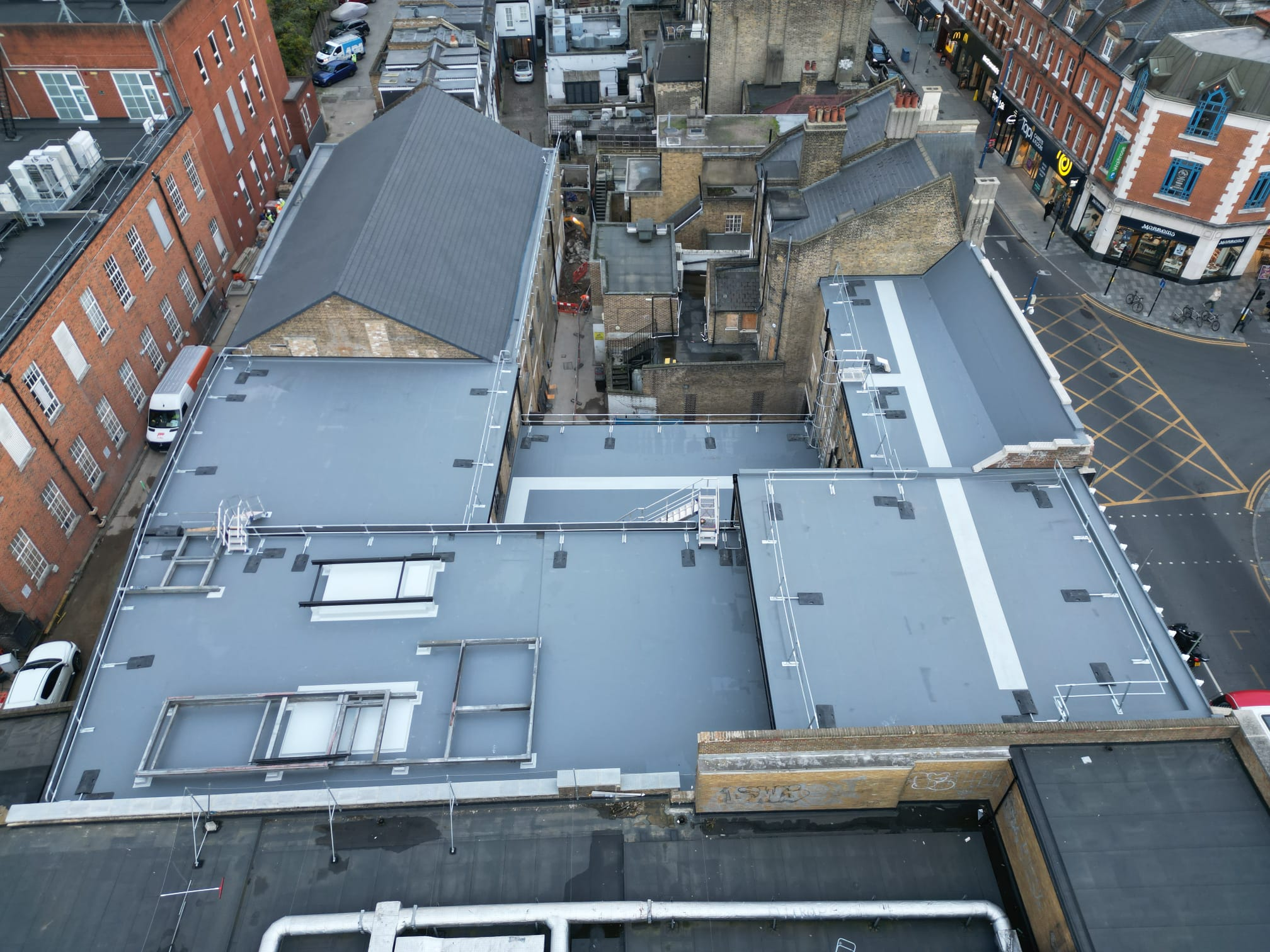


Marks & Spencer, Putney
Proteus Pro-Cold®
1,200 m²
APA Roofing & Waterproofing
This former M&S store had been closed for almost 8 years, during which time it had fallen into severe disrepair. When the project began, the building was derelict and years of neglect had taken a visible toll on both its interior and exterior, meaning the entire structure needed comprehensive renewal. Compounding the difficulty was the presence of significant asbestos-containing materials throughout the building. This meant that before any meaningful refurbishment could begin, extensive surveying, careful planning and stringent safety protocols had to be put in place. The sheer scale of the challenge meant that nothing about this project would be routine.
Proteus, working closely with contractors APA, undertook a full technical analysis of the roofing element – a far more complex challenge than a standard condition survey. The building included a patchwork of different deck types, including concrete, timber and Woodwool, many of which had badly deteriorated. Establishing which areas required a full strip-out, which could be retained and where new decking needed to be installed, demanded a precise, area-by-area assessment. Each section of the roof effectively became its own micro-project, with its own constraints and solutions, all of which had to be brought together into one coordinated envelope design.
Introducing new falls across the roof added a further layer of complexity. The building consisted of multiple interconnected roof zones, each with unique detailing challenges and interfaces. The team had to determine where the falls would be positioned and how they would integrate with existing structures, drainage routes and the differing roof geometries. Proteus overcame this problem with a unified strategy that ensured water management would be effective across all areas while still respecting the highly irregular nature of the building’s structure.
Thermal performance requirements further introduced additional technical challenges. Because the roof comprised different deck materials and required various insulation thicknesses, Proteus introduced weighted thermal calculations to ensure overall compliance without compromising individual sections. This was particularly demanding given the need to incorporate tapered insulation across the combined roof area. Every calculation had to be precise, coordinated and integrated into the wider build-up so that the entire system would perform as a singular, high-efficiency thermal envelope.
The project also included a substantial pitched roof section that required full renewal. Here, the team faced the task of integrating guttering within a hybrid waterproofing solution with a liquid-applied system that worked in conjunction with a built-up roofing system. Preventing condensation within the gutter zone, while maintaining performance, durability and visual consistency, was an additional technical challenge that required close collaboration between manufacturer expertise and on-site installation teams.
The project presented an unusually high level of complexity due to the condition of the building, its varied roof structure and the extensive works required to bring it back into a safe, functional and modern state. The M&S store had been closed for eight years, during which time it had suffered from neglect and exposure to the elements. Fire damage had also affected the high-level Yellow & Black roof, requiring a complete strip of the existing woodwool deck. Furthermore, a crash deck had to be installed to provide safe working platforms, while the roof, which contained asbestos, demanded careful removal and adherence to strict safety protocols. Creating appropriate falls further involved the installation of timber firring to direct water efficiently across the roof, supported by a full built-up roofing system applied to regulation standards.
In spite of this, the sloped roof posed additional challenges, requiring the existing timber deck to be stripped and over boarded with new 18mm OSB. This area demanded a tapered insulation scheme to manage water flow effectively, while ensuring that flat boards could be integrated seamlessly onto the slope. Walkways were additionally installed to provide safe access across these complex surfaces, adding another layer of difficulty.
The plant area roof, designated as the pink zone, further required the removal of a large area of plant, exposing the concrete deck beneath. New tapered insulation was installed in this area to ensure effective drainage and thermal performance.
The Orange roof further demonstrated the project’s intricacy. A quarter of this roof had to be stripped of woodwool, necessitating a crash deck and the addition of new firring to accommodate a 130mm flat board. The removal of plant and retention of plinths and steelwork also required careful planning to maintain structural integrity. The remaining sections of the roof were stripped back to thin timber deck boards, over boarded with new 18mm boards and additional firring for flat board insulation.
Replacing the pitched roof and its gutters was equally complex, with all timber stripped and renewed and an 80mm built-up roofing system installed to provide both insulation and waterproofing. Access to the site was severely restricted, complicating the logistics of deliveries, waste removal and the extraction of the large plant equipment.
At the height of the project, up to 50 workers were present on the roof simultaneously, carrying out multiple trades including door, window and lift shaft replacements. To ensure the roof’s performance and finish, a final 0.5mm layer of waterproof coating was applied across the system after all other trades had completed, providing a uniform, durable finish.
Overall, the combination of fire-damaged, asbestos-containing materials, varied roof types, restricted access and the need for precise coordination across multiple trades made this project exceptionally challenging.
One of the most significant technical challenges was the integration of sloped roofs into flat roof areas while ensuring the continuity and performance of the BUR system. Achieving a seamless connection between these differing geometries demanded detailed planning and bespoke solutions to guarantee water movement and prevent ponding, all while maintaining structural and waterproofing integrity.
Compounding the technical complexity was the ongoing store fit-out beneath the roof level. APA had to carefully sequence works to avoid interfering with internal trades, often adjusting installation methods and timing to accommodate simultaneous construction activities below. Coordination and communication were critical, ensuring that both the roofing works and internal fit-out progressed without delay or compromise.
The site also had severely restricted access, with minimal space for storage or staging of materials and waste removal required intricate planning. Deliveries had to be scheduled with precision and the team constantly monitored material flow to avoid bottlenecks or obstruction of trades. Each phase required foresight, flexibility and a proactive approach to overcome the limitations of the site.
Asbestos removal prior to the commencement of works introduced a significant safety challenge. APA had to work with heightened awareness of surrounding areas, ensuring that all trades operating nearby were protected. Safety measures and coordination with other contractors were paramount, with detailed plans developed to isolate affected zones and maintain a safe working environment throughout. The team’s ability to adapt to these constraints, balancing technical demands, safety requirements and ongoing operations, demonstrated exceptional problem-solving skills and operational intelligence.
The finished roof reflects the highest standards of care and professionalism. APA installed the Pro-Cold® BUR CTF system over the newly prepared timber substrate, ensuring that every detail was thoughtfully executed. The horizontal application of the coating was applied with precision, with all roller marks carefully aligned to create a uniform and visually appealing surface.
Upstands were properly boarded out prior to the system’s installation, resulting in crisp edges and clean lines throughout. Rainwater chutes were crafted with exacting precision, contributing to a cohesive and professional appearance across the roof. The finishing touches, including the newly installed pressed capping on the parapets and the termination bar, enhanced the overall polished look of the roof, providing both functional and visual benefits.
The Anti-Skid Inhibiting walkway system was carefully demarcated with straight, consistent lines and the addition of freestanding handrails added to the roof’s refined aesthetic. Each element, from the large expanses of flat coating to the intricate details around penetrations and upstands, demonstrated a consistent attention to detail.