


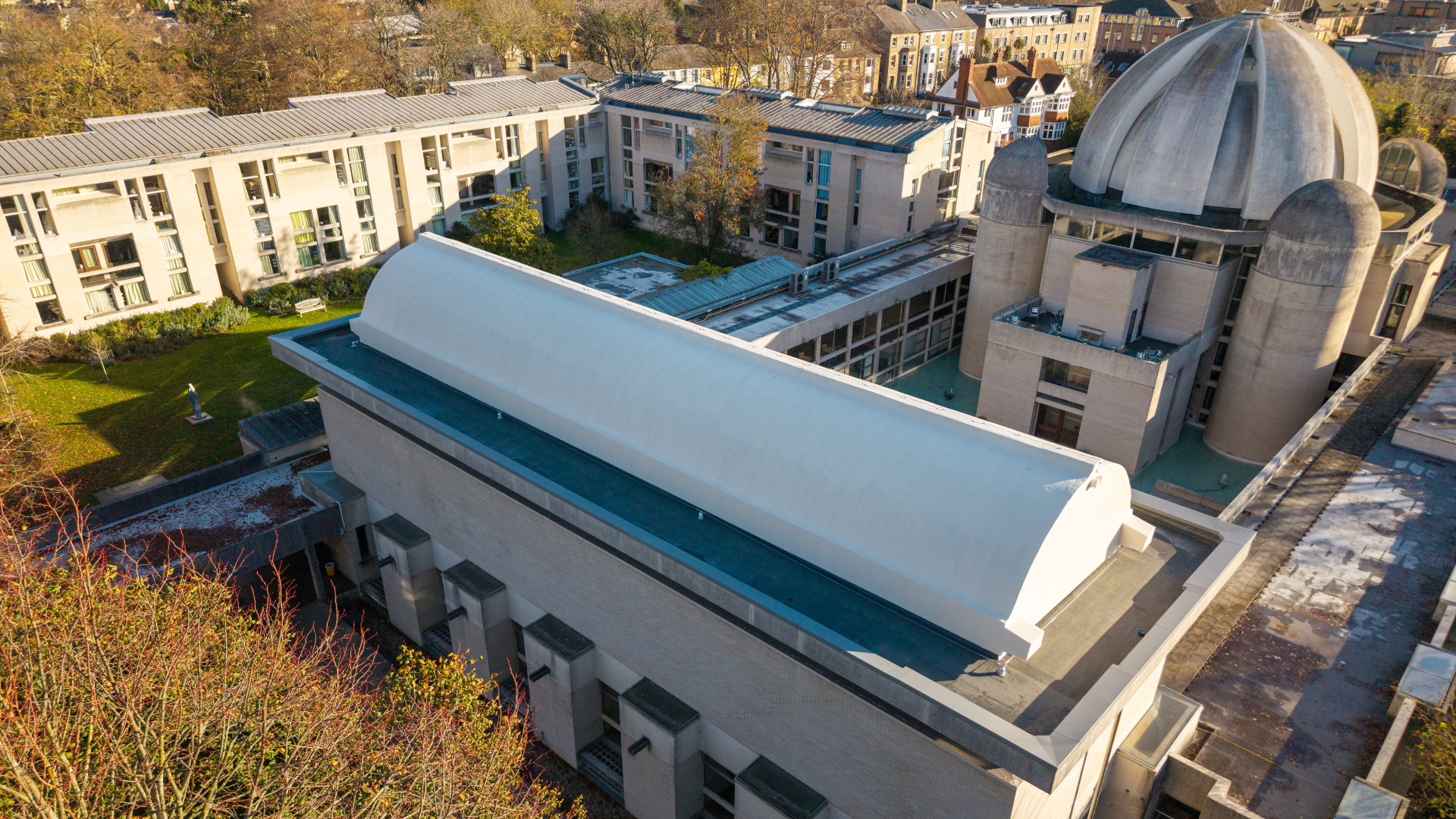


Murray Edwards College
Wecryl 230 Thix
400 m²
Millane Contract Services Ltd
Winner
LRWA Awards 2026 - Liquid Roofing Project of the Year Under 1000m²
The original refurbishment plan was to overlay the barrel roof with cold-applied PMMA liquid waterproofing membrane. However, during the initial survey, which included core samples and opening up works, the roof was found to be saturated, meaning a full strip-up was required.
Due to the listed status of the roof and being within a conservation area, any newly applied system would need to comprehensively match the appearance and the profile of the existing construction. As part of the waterproofing works, the flat apron roof which surrounds the barrel was also to be addressed and over-coated.
An absolute prerequisite of the project was that no mechanical fixings were permitted to be used within the precast concrete barrel sections or the vertical sides. This clearly provided substantial design and installation challenges when fully adhering a new warm roof system to the curvature of the precast vaulted roof, whilst the finished look had to be remarkable. The client was also extremely determined in satisfying their carbon-neutral ambitions for the new warm roof, which was discussed at great length during the design process.
Both the cold-applied waterproofing (Wecryl 230Thix) and the stippled white finish (Wecryl 420) are manufactured and supplied by WestWood and created one homogenous monolithic waterproofing membrane.
There was a limited time frame of a matter of weeks to complete this refurbishment, with works taking place during the college summer holidays. As part of a considerable design process where various warm roof options were discussed, all products which were to be subsequently chosen had to be readily available or on a short lead time. The fast-curing nature of a PMMA system also meant this was achievable.
During the initial survey, small areas of the barrel roof build-up were exposed, and core samples were taken from the barrel’s vertical sides, gable ends, and flat apron roof. Despite thorough investigation, the exact fixing and adhesion methods used in these areas could not be fully identified. As a result, the specification carried some risk of later adjustment. However, the proposed design could not deviate from a fully adhered warm roof build-up, as mechanical fixings were prohibited on the curved barrel. This imposed significant challenges in developing a thermally efficient, fully adhered system and in applying a liquid membrane to a curved structure.
Various warm roof options were evaluated, including mineral wool with battens, Foamglas, Rockwool Hardrock Multi-Fix DD, a hybrid Spacetherm Aerogel system, expanded polystyrene, and tissue-faced PIR. Each option was assessed for practicality, longevity, fire performance, and alignment with the client’s carbon-neutral goals. Ultimately, a prefabricated, spliced 140 mm tissue-faced PIR board was chosen, fully adhered using a rapid-curing two-part adhesive.
At project commencement, representatives from WestWood, Millane Contract Services, Watts, and the client attended the initial strip-up to refine the specification as hidden conditions were uncovered. Originally, the design intended to overcoat and encapsulate the parapet upstands on the flat apron roof. Closer inspection, however, revealed cross-ventilation beneath the apron, from the underside of the parapet capping to the underside of the existing insulation at the barrel’s upstands and gable ends. Because this ventilation gap needed to remain, a new support detail for the insulation was required.
A pre-waterproofed, once-bent aluminium angle was therefore installed, returned beneath the barrel roof and positioned above the air gap to protect inaccessible areas of existing insulation. A second once-bent aluminium angle with a drip bead was added facing outward to support insulation along the gable ends and vertical upstands. With mechanical fixings not permitted, these trims were secured using WestWood’s Wecryl 810 rapid-curing putty.
Further complexity arose from tensioned steel cables encased in protruding concrete along the vertical upstands, which form part of the building’s vaulted concrete structure. To bridge these protrusions, two layers of fully adhered insulation were required. Throughout the works, particular care was taken to ensure compliance with the building’s Grade II* listing, making it essential that the finished roof replicated the original appearance while meeting modern performance standards.
Comprehensive Training:
A bespoke training session was delivered for WestWood-approved installers already familiar with the products. A purpose-built timber rig was created to replicate the concrete barrel’s curvature, an unfamiliar shape for most installers. This allowed the team to rehearse techniques for achieving a smooth, glass-like finish, essential because laps in both the carrier membrane and polyester fleece would otherwise create visible high points. The mock-up also provided an accurate indication of the total resin required.
Highest Installation Competency:
A flawless finish to the waterproofing was crucial, as any imperfections would telegraph through the final Wecryl 420 textured surfacer. Although a thixotropic, rapid-curing cold-applied resin was specified, working on a curved structure remained technically challenging. After the concrete barrel was stripped back and fitted with a new vapour control layer, insulation, and carrier membrane, the waterproofing was applied at approx. 3kg/m² to meet the recommended rate. Additional resin layers were then added at roughly 0.5kg/m² per coat.
Between coats, installers sanded down high points at membrane laps, while Wecryl 810 Putty was used to fill low points, smooth ridges, and eliminate visible insulation board outlines. Once an overall coverage of approx. 6kg/m² (twice the normal rate) had been achieved, the entire vaulted barrel was extensively sanded, with Wecryl 810 applied wherever minor indentations remained. Around 150 man-hours of sanding were required to achieve the demanded glass-like finish, with great care taken not to compromise the waterproofing integrity.
Supreme Aesthetics:
The final textured layer had to match the sample board previously approved by both the conservation officer and the client. To replicate the original stippled render, the finish had to be applied in two directions to avoid a rippled effect. Achieving a uniform appearance required each full section, such as an entire side of the barrel—to be completed in a single continuous operation, demanding precise coordination among the installation team.
Having the ability to utilise a monolithic waterproofing system with the ability to recreate a textured white render-like finish was an absolute prerequisite and necessity for the project.
The undertaking of a project-specific training session also greatly assisted in understanding the parameters of the installation, the desired finish, and any issues which may arise along the way and subsequently how best to react to any issues which may arise.
To help support the decision of specifying a fully adhered pre-fabricated spliced tissue-faced PIR board, two sample pre-spliced PIR boards were produced and offered up to the existing roof curvature to ensure that they were suitable and that the proposed specification was achievable before the specification was finalised. The sample boards had different splicing spacing to see which one suited the profile of the roof.
At the abutment and change in angle where the concave barrel curve met the vertical upstands, a template was created to illustrate the exact profile of insulation infill required at this point to avoid any cold spots being created between the continuous barrel insulation and the vertical insulated upstands.
At the ridge along the barrel, as well as where the barrel abutted the vertical upstands to the sides, the curvature of the roof was seen to change from convex to concave. To replicate this curve, WestWood’s rapid-curing Wecryl 810 putty was applied. A specifically made profiled float was created for the application of the putty at these points. Two profiled floats were made for each upstand abutment along the sides, as well as two floats for either side of the ridge line curves.
The use of WestWood’s Wecryl 810 Putty became more prevalent as the project progressed. As well as being used to paste out the concave curves and any indentations on the barrel, Wecryl 810 was also utilised in achieving a smooth glass-like finish and to help alleviate any visible protruding edges of the insulation boards. As mechanical fixings were not permitted along the bottom of the vertical barrel upstands, nor the gable ends, Wecryl 810 Putty was ideal for robustly securing the fabricated aluminium trims before the insulation was installed to the vertical areas.
A rapid-curing adhesive was specified due to the nature of the installation onto a curved substrate. The insulation also needed to be retained/ weighted down whilst the adhesive took effect. As part of the bespoke training session, the pre-spliced sample boards were adhered to the timber rig and restrained to help gauge the curing times and any likely issues that may be encountered on site.
When it came to the final rigorous sanding of the resin prior to the final textured layer being applied, the sanding had to be sequenced due to the amount of dust which was being created. This meant that the top half of the barrel first needed to be sanded before the lower part of the barrel and the vertical upstands were then addressed.