


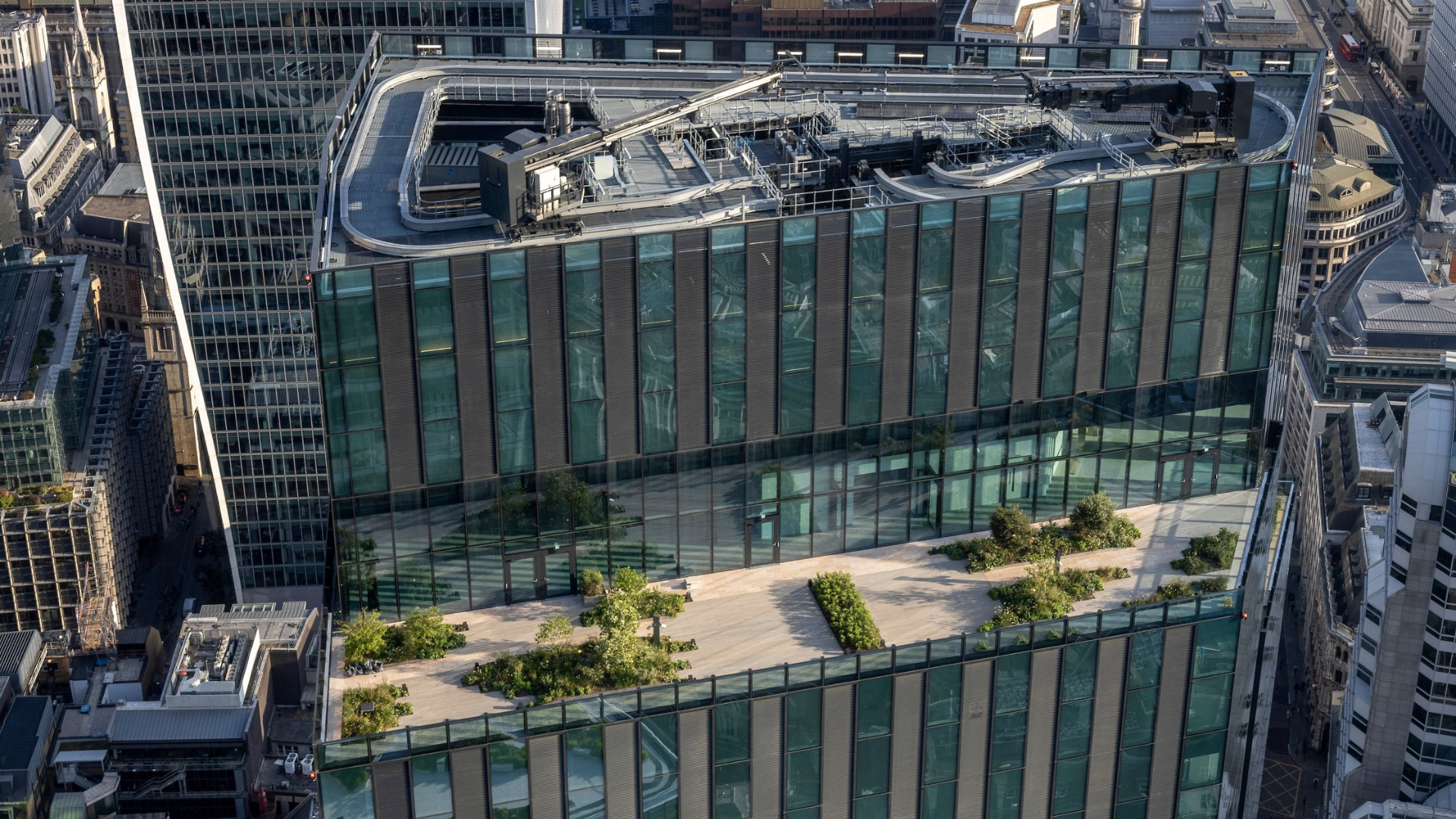


One Leadenhall
Radmat Permaquick PQ6100
2,788 m²
Lindner Prater Ltd
Winner
LRWA Awards 2026 - Liquid Roofing Project of the Year in a Buried Application
Rising 165 metres above the heart of London’s financial district, One Leadenhall is a striking 35 storey commercial build that brings a new generation of workplace, retail and public amenity to one of the most historically sensitive sites in the Square Mile.
Designed by Make Architects for Brookfield Properties, the development delivers approximately 40,000 m² of Grade A office accommodation supported by 8,000 ft² of retail and dining space, over 700 cycle spaces, electric vehicle charging points, and exceptional public transport connectivity, with four major stations within a five-minute walk. The project also offers panoramic views across London and connects seamlessly with the historic streetscape below, making it a true exemplar of design, innovation and delivery. Its elevated public terrace and viewing gallery offer panoramic views across the capital, a people centric, historically sensitive and a prominent addition to the City of London skyline.
Set directly beside the Grade II-listed Leadenhall Market, whose origins date back to the 14th century, and above the remains of London’s ancient Roman Basilica, One Leadenhall occupies a historically significant site. The market was the only one to survive the Great Fire of London in 1666, with its celebrated Victorian structure, designed by Sir Horace Jones, completed in 1881. The project required exceptional sensitivity in design and execution, balancing innovative modern architecture with respect for the area’s historic surroundings.
Our scope was to deliver the roofing package comprising of multiple terraces, plant decks, and roof areas spanning a complex, multi-level roofscape. We were appointed by Multiplex to deliver a comprehensive hot melt waterproofing package Roof insulation and filter sheets providing a high-performance, thermally efficient roof suitable for the building’s ambitious sustainability targets. In addition, the leadwork, paving and cold applied detailing was also within our scope.
One Leadenhall is a showcase of contemporary roofing engineering, combining advanced waterproofing, high-performance insulation and aesthetic finishes to deliver a roof that supports both the building’s operational needs and the surrounding historic environment.
One Leadenhall incorporated a combination of inverted roof systems, leadwork interfaces at party walls, and paved finishes, with precast paving slabs supported by adjustable pedestals or ballast as appropriate. Roof levels included complex terraces at Level 4, 5, 29–34, and the uppermost roof, each with bespoke specifications to address pedestrian access, drainage, and aesthetic requirements. Column casings, roof boxes, and BMU interfaces were integrated seamlessly with the waterproofing systems, reflecting a holistic approach to design and installation.
A particularly complex challenge was installing a new lead detail to the Level 2 party wall, connecting One Leadenhall to the existing Grade II listed Leadenhall Market. The work required stripping the existing lead, building up top hats to the existing structure, and forming a new lead gutter system that seamlessly interfaced with the newly installed façade while maintaining aesthetics and functionality. Operatives worked in tight spaces between the walls, continuously clipped onto a bespoke inertia monorail and harness systems for safety, while electric winches were used to lift and lower heavy materials.
The primary waterproofing system, Radmat PermaQuik hot melt, was applied across all terraces, plant decks, and inverted roof areas. Junctions, penetrations, and party wall interfaces required the use of ReadySeal cold liquid applied membrane to accommodate movement and ensure watertight performance. Sequencing these trades was critical to avoid conflicts between waterproofing, paving, and leadwork.
For complex interfaces, junctions, and penetrations, such as at Level 2 party wall interfaces, column casings, and roof boxes, ReadySeal Cold Liquid Applied Waterproofing Membrane was employed to provide additional sealing and flexibility where required. Column casings around fire-rated steel were carefully detailed to avoid compromising fire protection and waterproofing, with bespoke fabrication and installation sequences.
Coordination with multiple subcontractors, architects, and engineers ensured seamless delivery, meeting all performance, aesthetic and sustainability targets.
One Leadenhall presented distinctive logistical challenges, especially in lifting materials over one of Bishopsgate’s busiest roads. Its sensitive central location and the persistent challenge of working at a height of 165m, amid wind, weather, and logistical intricacies, demanded meticulous planning, just in time deliveries and coordination between the Main Contractor, logistics teams and other trades to ensure the project’s on-time and on-budget execution was achieved.
Further complexity arose from tensioned steel cables encased in protruding concrete along the vertical upstands, which form part of the building’s vaulted concrete structure. To bridge these protrusions, two layers of fully adhered insulation were required. Throughout the works, particular care was taken to ensure compliance with the building’s Grade II* listing, making it essential that the finished roof replicated the original appearance while meeting modern performance standards.
The installation of roofing at One Leadenhall exemplified precision, innovation, and collaborative high-rise working. Our team delivered a complex hot-melt waterproofing system across terraces, plant decks, and inverted roof zones, utilising Radmat PermaQuik, reinforcing fabric, and Texsa protection sheets. Teams were strategically divided to manage multiple roof zones concurrently while maintaining consistent quality standards.
On Level 33, a three-team approach was adopted for the cold-applied weathering and perimeter detailing. The first team installed structural metal supports along parapets, creating a stable base for waterproofing and finishes. The second team applied a cold-applied waterproofing detail, including VCL layers, foamglass, and paraflex overcoats, ensuring a seamless transition between the hot-melt roof and perimeter edges. The third team installed bespoke column casings around fireproofed steel elements. Each stage was QA-checked by independent inspectors, project management, and the design team, ensuring full compliance with functional, aesthetic, and heritage requirements while maintaining the contracted programme.
Leadwork installation at Level 2 party walls exemplified specialist craftsmanship. Operatives worked continuously clipped into bespoke inertia monorail systems, stripping existing lead and forming new details that interfaced seamlessly with the Grade II listed Leadenhall Market. Top hats were fabricated on-site to accommodate structural variations, and a precision-engineered lead gutter system was installed to maintain both functionality and visual coherence. Electric winches facilitated safe material handling in constrained areas, and careful staging ensured safe access while working at height.
High-rise challenges demanded innovative material handling and site logistics. Lightweight insulation and paving materials were secured with weighted nets, tested off-site with results shared with the NFRC, and delivered via hoists and cranes to upper roof levels. Flood testing verified the integrity of waterproofing and drainage systems. Scaffold adaptations, including edge protection, and Mobile Elevating Work Platforms (MEWPs) were deployed to ensure safe access to all areas, including the Level 2 Party Wall.
Throughout all roof levels, meticulous attention to detail was combined with strict adherence to health, safety, and environmental protocols. Materials were staged and secured, and teams maintained consistent skill levels throughout the project. Apprentices and trainees were actively integrated into installation teams, gaining hands-on experience in high-rise roofing, hot-melt waterproofing, and heritage leadwork detailing.
One Leadenhall demonstrates how careful planning, technical skill, and innovative processes can successfully overcome the challenges of high-rise, heritage-sensitive, and complex roof delivery.